Quick answer: A silicone coating is the right choice when the existing roof is worn but structurally sound, the insulation is dry, and there is only one or two layers. A full replacement is required when the insulation is wet across a large area, the deck is deteriorated, or the membrane has failed system-wide. A moisture survey is what tells you which situation you are in.
Every aging commercial roof eventually reaches a fork: restore it or replace it. Property managers are right to be skeptical of both answers, because a contractor who only sells replacements will recommend a replacement, and a contractor who only sells coatings will recommend a coating. The honest answer depends on what is under the membrane, and there is a straightforward way to find out.
What a Silicone Restoration Actually Does
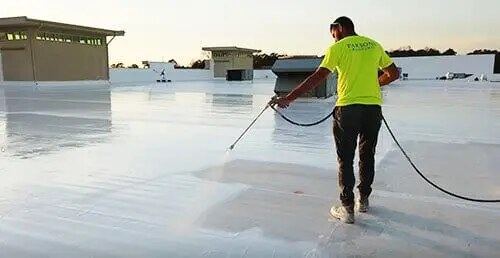
A silicone coating system does not replace the roof. It repairs the existing membrane at seams, flashings, and penetrations, then seals the entire surface with a fluid-applied silicone layer that cures into a seamless, waterproof, reflective membrane. The existing roof stays in place and continues to do its job as the substrate. The coating carries its own warranty, typically tied to the thickness applied.
What it does not do is fix what is underneath. Wet insulation stays wet. A rotted deck stays rotted. That is the entire decision in one sentence.
Signs Your Roof Is a Coating Candidate
- The membrane is chalking, weathered, or showing surface wear, but is not split open across large areas
- Leaks, if any, are localized and traceable to specific seams, flashings, or penetrations
- The roof has one layer, or two at most
- The deck is sound with no soft spots
- A moisture survey shows the insulation is dry, or wet areas are small enough to cut out and replace
- Ponding, if present, is shallow and drains within a day or two
Signs You Need a Replacement
- Wet insulation across a significant percentage of the roof area
- Deck deterioration, soft spots, or rust-through on a metal deck
- Membrane failure across the field of the roof, not just at details
- Already two or more layers, which most codes will not allow you to build on
- Insulation that no longer meets energy code and needs to be brought up during the project
- Chronic deep ponding that indicates a structural or slope problem a coating cannot fix
The Moisture Survey Is the Whole Decision
The only way to know what is under a membrane is to test it. There are three common methods. An infrared scan, done at dusk after a sunny day, shows wet insulation as warm areas because water holds heat longer than dry insulation. A nuclear moisture gauge reads moisture content at grid points across the roof. Core samples physically cut a small section out to see the layers and feel the insulation. A good contractor uses at least one of these before quoting either a coating or a replacement, and shows you the results.
If a contractor recommends a coating without checking for moisture, be careful. Sealing water into a roof is one of the fastest ways to destroy it.
Where the Money Goes in Each Option
A replacement pays for tear-off labor, disposal, new insulation, new membrane, all new flashings, and often crane time. A coating pays for repairs and prep, reinforcement at details, and the coating itself. The coating is a fraction of the replacement cost for the simple reason that most of the expensive items in a replacement do not exist in a restoration. The tradeoff is that a coating buys a defined number of years on the existing roof rather than resetting the clock entirely.
Other Factors Property Managers Weigh
Tenant disruption. A coating has no demolition, no dumpsters, no crane on the street, and no interior access. For an occupied retail plaza or office building, that alone can tip the decision.
Timing. If the building is being sold in a few years, a coating with a transferable warranty can be the better capital decision. If it is a long-term hold, resetting the clock with a replacement may be.
Energy. White silicone is highly reflective. On a dark EPDM or modified bitumen roof over a conditioned space, a coating can deliver a cooling benefit similar to a new white TPO roof.
Accounting treatment. Many owners are able to classify a restoration differently from a capital replacement. That is a question for your accountant, but it is worth asking before you decide.
A Reasonable Path
Get a moisture survey. If the roof is dry and sound, a coating is very likely the right answer and will save real money. If it is wet, replace it and do not let anyone talk you into sealing the water in. If it is in between, with a few wet areas, a repair-and-coat approach where the wet sections are cut out and replaced before coating is often the best of both. We do all three across New Jersey, New York City, and Long Island and will tell you which one your roof needs after we look at it. Learn more about our silicone coating systems or request a roof assessment.