Quick answer: Tear-off and installation on a typical single-story commercial building runs one to three weeks once crews are on the roof, depending on size and roof type. The full project, from signing a contract to final walk-through, usually takes four to ten weeks, because ordering materials, scheduling, and weather windows add time before and after the physical work.
Property managers and building owners almost always ask the same question first: how long is my roof going to be under construction? It is a fair question, because a commercial roof replacement affects parking, deliveries, rooftop equipment access, and sometimes tenants directly below the work. The honest answer has two parts, the on-roof work itself and everything around it, and both matter for planning.
The Number That Matters: Total Project Timeline
From the day a contract is signed to the day the roof is finished and closed out, a straightforward commercial replacement typically runs four to ten weeks. That includes material ordering and lead time, scheduling the crew, permitting where required, the physical tear-off and installation, and a final inspection and closeout. Large or complex roofs, or projects that hit a stretch of bad weather, can run longer. This is the number to use when planning around tenants, deliveries, or a budget cycle, not the on-roof duration alone.
On-Roof Time: What Actually Happens Once Crews Arrive
| Roof size | Typical on-roof duration |
|---|---|
| Under 10,000 sq ft | 2 to 5 days |
| 10,000 to 50,000 sq ft | 1 to 2 weeks |
| 50,000 to 150,000 sq ft | 2 to 4 weeks |
| Over 150,000 sq ft or multi-building | 4+ weeks, often phased |
These ranges assume a single-ply system (TPO or EPDM) going over a dry deck with no major structural surprises. A full tear-off to the deck takes longer than a recover. Multiple existing layers that have to come off add time. Complex roofs with many curbs, penetrations, and drains take longer per square foot than a large, open field.
What Drives the Schedule Up or Down
- Roof size and shape. A simple rectangle moves faster than a roof broken into multiple sections by HVAC curbs, parapets, and roof-mounted equipment.
- Tear-off vs. recover. Removing the existing roof down to the deck takes longer than installing over a sound existing surface, when a recover is code-permitted.
- Deck condition. Wet insulation or deteriorated decking discovered mid-project adds repair time that cannot always be predicted in advance.
- Material lead time. Membrane, insulation, and specialty flashing materials can have order-to-delivery windows of one to several weeks depending on the manufacturer and time of year.
- Weather. Membrane installation generally requires dry conditions and a workable temperature range. A rainy stretch pushes the schedule, and winter installs in the Northeast build in more contingency days.
- Building occupancy. Work over an occupied retail space or above sensitive equipment sometimes requires phased sections or off-hours work, which extends the calendar even though the total labor hours are similar.
A Typical Week-by-Week Breakdown
For a mid-size roof (roughly 20,000 to 40,000 sq ft) on a single-story commercial building, a realistic schedule looks like this:
- Weeks 1 to 3: Contract signed, materials ordered, crew scheduled, any required permits pulled.
- Week 4: Mobilization, staging, and protection of the site begin the day work starts.
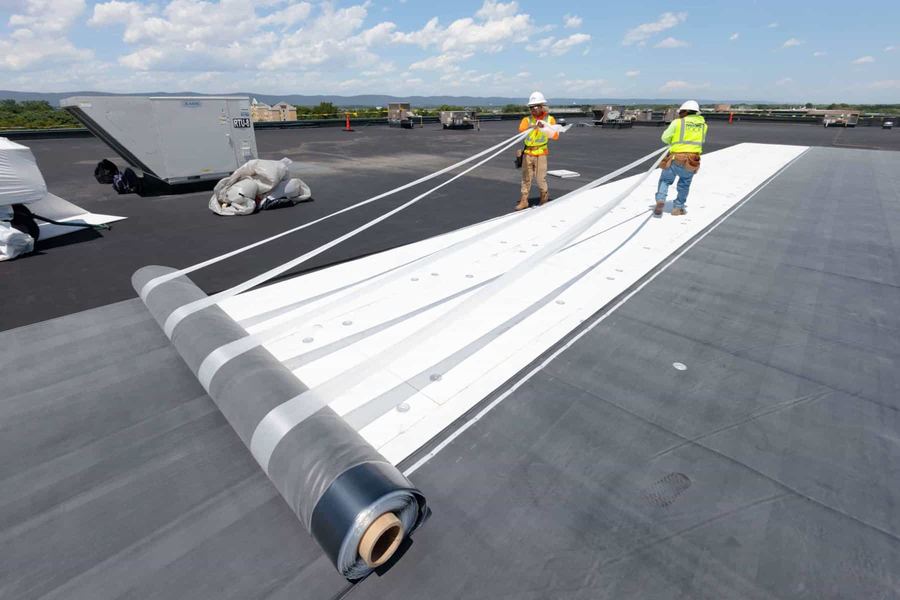
- Weeks 4 to 5: Tear-off and installation, done in sections so the building is never fully exposed at once.
- Week 6: Final flashing details, drain work, punch list, and closeout walk-through with warranty documentation.
Smaller roofs compress this; larger or more complex ones extend it, mainly on the ordering and on-roof phases.
How to Plan Around It
Start the conversation with a contractor further ahead than the on-roof duration would suggest. Ordering materials early, especially for specialty membranes or during peak season, is usually what protects the schedule more than anything that happens once crews are on site. If the building has tenants, coordinate parking and delivery access before the start date rather than during it. If any interior work depends on the roof being closed in, build in a buffer past the contractor's estimated finish date rather than scheduling the next trade for the exact last day.
A roofing contractor who gives a specific, itemized timeline, ordering lead time, on-roof duration, and closeout, broken out separately, is giving you a schedule you can actually plan around. One who only gives a single vague number is not.
For a schedule specific to your building, a roof assessment gives you real numbers instead of a general range.